
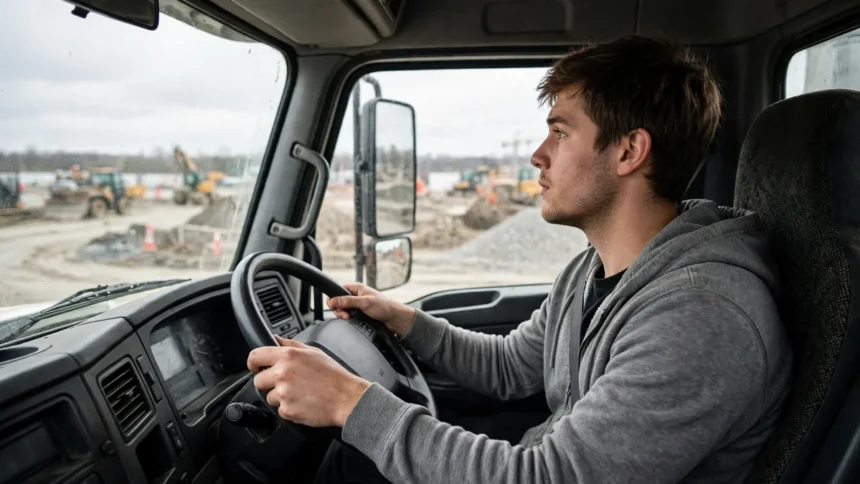
A 5-yard dump truck is the biggest truck you can drive without a commercial licence, and it drives like a heavy pickup — not like a car, and not like a semi. The first time you take one out, the brakes take longer, the turns take wider, and the mirrors matter more. Ten careful minutes before you leave the yard and a slower pace for the first few miles handles all of it. This guide covers what to check, how the truck handles loaded and empty, and how to dump safely — so your first trip is an ordinary one. If you are still deciding whether you need a commercial licence at all, our guide to non-CDL dump truck rental explains the 26,001-pound rule.
Before you drive: the walkaround
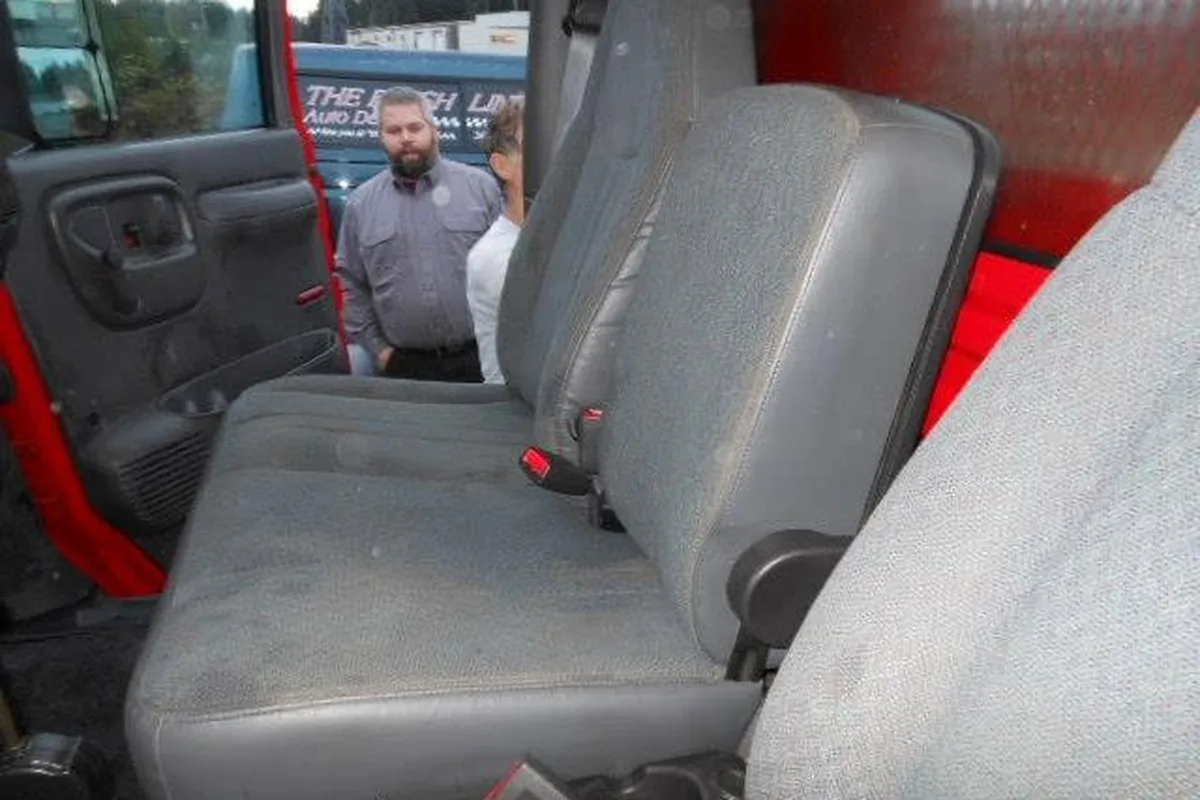
Do the walkaround in our yard before you leave. Check the tyres for cuts and bulges, look under the truck for leaks — oil, coolant or fuel on the ground is a reason to say something, not to drive away — and if you are towing, check the hitch, the plug, the safety chains and the trailer brakes. Inside the cab, test the brakes, horn, lights and mirrors before you move, and make sure the dump bed is fully lowered. A half-raised bed is dangerous on the road: it can hit overhead wires and signs, and it throws the truck off balance in a turn. Adjust the mirrors so you can see both sides of the bed, and find the brake controller, the bed switch and the hazard lights before you need them. If anything feels wrong, tell us in the yard. Spend ten minutes driving slowly around the yard first — brake a few times, turn, and practise reversing with the mirrors.
Braking, turning and blind spots
Three things change the moment you step up to a large truck: stopping, turning and seeing. A loaded dump truck takes much longer to stop than a car, so leave extra space ahead and watch the brake lights two or three cars in front of you. Brake early and gently. Turns need more room than you think: swing wide, watch the rear wheels, and never cut a corner short, because the back of the truck tracks inside the front. And the blind spots are real, so check your mirrors constantly, be aware of pedestrians and cyclists that may be hidden beside the bed, and never assume a driver in your blind spot has seen you.
Loaded vs empty: how the truck changes
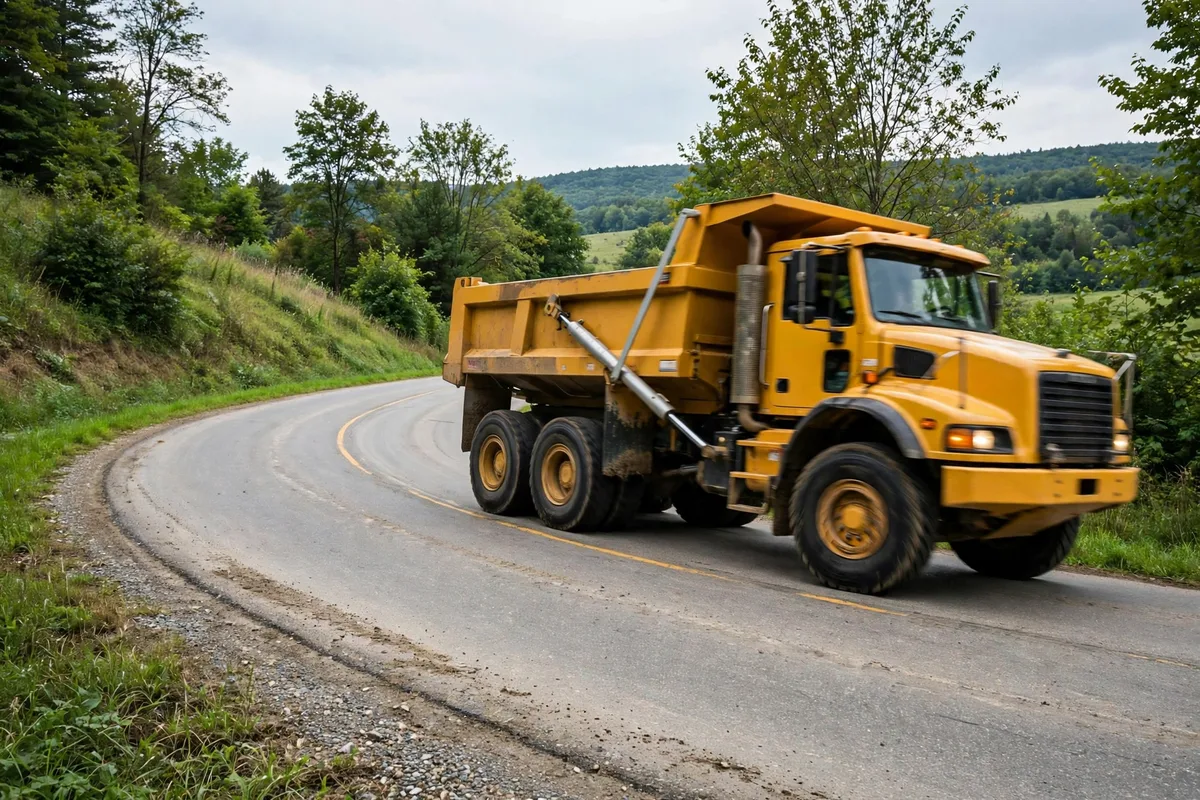
The same truck handles differently loaded and empty, and the load is the reason. A full bed raises the centre of gravity, which makes the truck more likely to tip on uneven or sloped ground. Heavy or loose material can shift during a turn or a sudden stop, and a shift can destabilise the truck fast. So load evenly — if the material sits too far to one side or piles up too high, it can shift when you move or dump. Drive slower with a full load, take turns wider and slower, and stay off steep or soft ground. Empty, the truck stops faster but rides harsher. Check the bed is fully lowered before moving.
Dumping safely
Dumping is where most first-timer mistakes happen, and all of them are avoidable. Pick a firm, level spot with enough room to reverse and exit — never dump on soft or sloped ground, where the truck can shift as the bed goes up. Keep everyone clear of the back and sides of the truck while you unload: gravel, dirt and rock fall fast and wide if the load shifts. Raise the bed, let the load out, and bring the bed all the way down before you move. Never drive with the bed raised, even a short distance. When you are done, bring the truck back to our yard at 17519 Canyon Rd E, Puyallup, WA 98375 — we are open 24/7, so a late return is not a problem.
What you need to rent a dump truck
Three things, and none of them is a commercial licence. First, a valid driver’s licence — the one you already carry. Our self-drive trucks sit under the 26,001-pound line, so a Class B licence is not needed. The federal rule is the Federal Motor Carrier Safety Administration’s, 49 CFR 383.91 — you can read it on the Federal Motor Carrier Safety Administration site, and the Washington State Department of Licensing explains when Washington requires a CDL. Second, to be old enough: most rental companies require renters to be 21 or older, some 25 for larger trucks — market practice, not our rule. Ask us when you call. Third, insurance: confirm it when you call — we do not publish an insurance policy on this site. When you call or text (253) 318-2428, tell us what you are hauling, which truck you need and the dates, and we will confirm the rate before you book.
Watch: a visual walk-through of safe dump truck operation from Herc Rentals — How to Safely Operate a Dump Truck (video). It covers the inspection, loading, driving and unloading steps in this guide.
Frequently asked questions
Do I need a CDL to drive a dump truck?
Not one of ours. Our self-drive dump trucks sit under the 26,001-pound GVWR line, so a valid driver’s licence is all you need. A single vehicle rated 26,001 pounds or more needs a Class B CDL.
How fast should I drive a loaded dump truck?
Slower than the traffic around you, and slower than you would drive the same truck empty. A loaded truck takes longer to stop, turns wider, and carries a load that can shift. Keep your speed down, brake early, and give yourself extra space ahead.
What should I check before driving off?
Tyres, leaks underneath, the dump bed fully lowered, brakes, horn, lights and mirrors, and the hitch, plug and safety chains if you are towing. If anything feels wrong, tell us in the yard before you leave.
Can I practise in the yard before I leave?
Yes — that is what the first ten minutes are for. Drive slowly around the yard, brake a few times, make a full turn, and practise reversing with the mirrors. If you have never driven a truck this size, say so and we will walk around it with you.
Call or text (253) 318-2428 to rent a dump truck for the first time. Tell us what you are hauling and that it is your first time — we will match you to the right truck and walk around it with you first. Our yard at 17519 Canyon Rd E, Puyallup, WA 98375 is always open, 24/7.